
How to Choose the Right Rubber Tile for Shooting Range Flooring?
At first glance, rubber tiles may look the same. But choosing the wrong tile for a shooting range can lead to serious safety issues, costly replacements, or poor performance.
The right rubber tile depends on where it’s used—floor, wall, or backstop. To choose correctly, consider zone function, bullet energy, structure type, and maintenance strategy.
We’ve worked with shooting range contractors, gym builders, and even tactical facility operators. The biggest mistake they make? Assuming gym rubber = ballistic rubber.
Let’s walk through how to avoid that.
What Factors Matter When Choosing a Shooting Range Rubber Tile?
Rubber thickness is important—but not enough.
To choose the right tile, consider:
- Where it will be used (floor, wall, or trap)
- What type of bullet energy it needs to absorb
- How often the area will be used
- Which structure the rubber tile is made from
- Whether you’ll need to replace tiles over time
👉 Spoiler: Not all “thick” tiles are safe. Structure matters more.
You can read more about this in our foundational article:
🔗 Can Rubber Tiles Be Used for Shooting Ranges?
Which Area Will the Tile Be Installed In?
Different zones = different risk levels = different rubber tile requirements.
| Application Zone | Typical Risk | Recommended Material |
|---|---|---|
| Floor (ricochet zone) | Low penetration, high impact | High-density rubber tile (40–60mm) |
| Side wall / corner | Fragmentation, lateral rebound | Laminated or fiber-filled rubber tile (60–80mm) |
| Bullet trap / backstop | Direct bullet hits | Ballistic rubber block (≥80mm, continuous fiber structure) |
👉 For detailed thickness suggestions, see:
🔗 Recommended Rubber Thickness and Structure for Shooting Ranges
What Structure Performs Best: Granule or Fiber-Filled Rubber?
This is where many people get it wrong.
Most gym rubber tiles are made from fine SBR granules, compressed under heat. They work well for:
- Weight impact
- Shock absorption
- Foot traffic
But for bullet energy, they fail. Granular structure is easily torn, especially at high speed.
Instead, shooting ranges need:
- Fiber-filled rubber (shredded tire strands pressed densely)
- Continuous molded rubber blocks with no weak bonding points
These materials are used in military and police shooting ranges worldwide. For reference, see NIJ Standards for Ballistic Resistance.
Can the Tile Be Easily Replaced or Maintained?
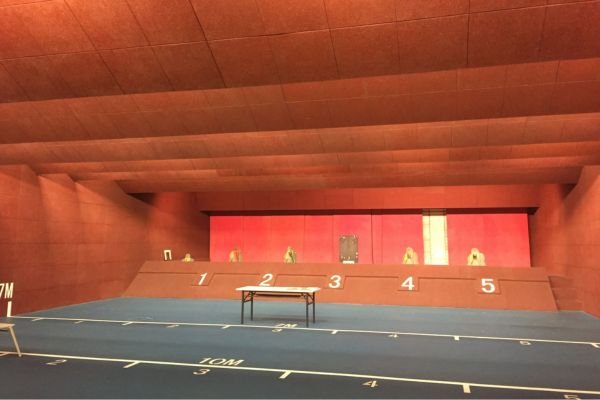
This is a huge advantage of using tiles instead of full-size rubber walls.
When choosing rubber tiles:
- Use modular sizes: 500×500mm or 1000×1000mm
- Prefer square or interlocking tiles over sheets
- Ask: Can I replace only damaged zones?
For example, Lanhefloor tiles are:
- Precision-cut or molded
- Stackable and cuttable
- Easy to install and replace
This makes a big difference for long-term cost—especially in high-use indoor ranges.
External Consideration: Certification or Not?
You don’t always need ballistic certification.
In most commercial shooting ranges, rubber is used for:
- Ricochet reduction
- Wall protection
- Sound absorption
Unless you’re building a certified bullet-trapping backstop, ballistic reports like NIJ or EN1063 may not apply.
But for public/military projects, you should reference external standards like:
- US Army Corps of Engineers Range Design Guide
- National Institute of Justice (NIJ)
At Lanhefloor, we support:
- Product density & hardness data
- Shore A and tear strength tests
- Long-fiber structure blocks (for bullet zones)
Frequently Asked Questions (FAQ)
Is 50mm rubber tile enough for a shooting range?
Only for floors and ricochet zones. Not for walls or bullet traps.
Can I use gym rubber tiles for tactical training zones?
Only for non-ballistic areas like yoga/stretch zones or general traffic zones.
How do I know if I need fiber-filled tiles?
If your area will receive any direct bullet energy, or you’re protecting side walls, choose fiber-based tiles or blocks.
What size rubber tile is easiest to maintain?
500×500mm or 1000×1000mm square tiles are the most modular and cost-effective for long-term use.
Conclusion
Choosing the right rubber tile for a shooting range means thinking in zones, not just material.
Ask: What will hit it? How often? How do I maintain it?
If you’re unsure, we’re happy to help.
📧 info@lanhefloor.com
🌐 https://www.lanhefloor.com