
Why Does My EPDM Playground Floor Turn White, Crack or Bubble?
Many customers send me photos of their EPDM floor after a few months.
They ask the same thing again and again:
“Why is it turning white?”
“Why are there small cracks?”
“Why are there bubbles on the surface?”
Most of the time, the floor is not “bad”.
It just needs the right explanation, and sometimes a simple repair.
In this article, I will use simple words to explain three common problems:
- EPDM turns white after rain
- EPDM surface gets cracks
- EPDM surface has bubbles or bulges
For each one, I will share:
- Why it happens
- How you can fix it
- How to avoid it in future
1. Why EPDM Wet Pour Flooring Turns White After Rain
Whitening is one of the most common questions I get.
Many people think the color is gone or the EPDM is poor quality.
In most cases, the real reasons are:
1.1 Why it turns white
a) Moisture and binder reaction
If it rains during or soon after installation, water can sit on the surface.
The PU binder reacts with this moisture.
A thin white film appears on top.
b) Very humid weather during curing
If the air is very humid, the surface does not cure in a clean way.
Small white “fog” or patches show up.
c) Using one-component binder outdoors
One-component binder cures with moisture in the air.
In wet conditions, it may look cloudy or white.
Two-component binder is more stable for outdoor playgrounds.
You can read more about this here:
One-Component vs Two-Component PU Binders for EPDM Flooring
d) Too much binder or uneven mixing
If there is too much binder in some areas, or it is not mixed well, the extra binder may come to the surface and turn white after rain.
1.2 How to fix whitening
The good news: whitening is often only on the surface.
You can try:
- Let the floor dry in sun and wind for a few days
- Wash the surface with clean water
- Lightly brush or scrub and then rinse
- For strong whitening, lightly sand the top and wash again
- In some cases, apply a clear PU sealer to bring back a fresh look
If EPDM granules themselves are high quality, the color is still there under the white layer.
Our own EPDM granules are designed with strong color stability for long-term outdoor use.
1.3 How to prevent whitening
You can reduce whitening risk by:
- Avoiding installation in rain or very humid days
- Making sure the base is dry before you start
- Using two-component binder for outdoor projects
- Mixing binder and granules well, with the right ratio
- Using low-dust, clean EPDM granules
If you want to check if your EPDM supplier is reliable, you can read this guide:
How to Choose Reliable EPDM Granules Suppliers in China
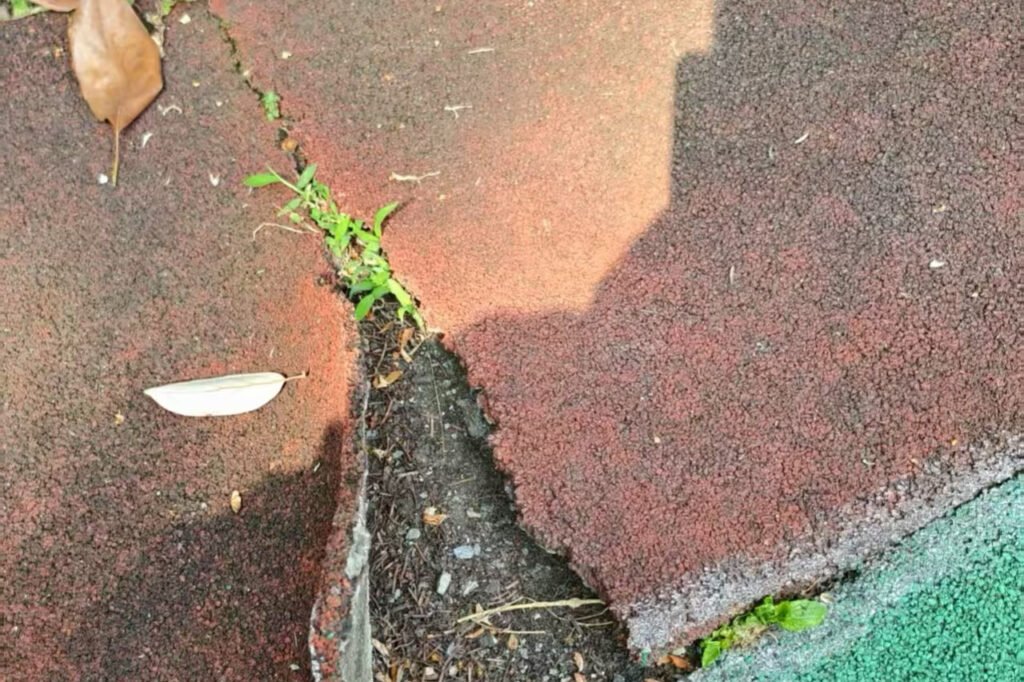
2. Why EPDM Wet Pour Flooring Gets Cracks
Cracks look scary, but they do not always mean the whole floor fails.
Most cracks come from the ground or installation process, not from the EPDM itself.
2.1 Why cracks appear
a) Movement in the base
If the concrete or asphalt under the EPDM moves, cracks can appear on the surface.
This may come from weak soil, bad compaction, or heavy loads.
b) Uneven thickness
If some parts are much thinner than others, thin areas can become stiff and break more easily.
c) Very hot weather during installation
If the sun is strong and the ground is hot, the binder cures too fast.
This can create internal stress and fine cracks over time.
d) Low binder ratio
If there is not enough binder in the mix, the granules do not hold together well.
The surface becomes hard and brittle.
e) Poor mixing
If binder is not mixed evenly with granules, some zones are weak.
More details about poor bonding and surface failure are in this article:
Why EPDM Granules Fall Off After Installation
2.2 How to fix cracks
For small cracks:
- Cut the crack open into a neat V-shape with a knife
- Clean out loose pieces and dust
- Mix fresh EPDM granules with the correct amount of binder
- Fill the crack with the mix
- Press and smooth with a steel trowel
- Let it cure for at least 24 hours before use
For large or many cracks, it may be better to repair a full section.
You cut the damaged area into a rectangle, remove it, and refill with new EPDM mix.
2.3 How to prevent cracks
You can lower the risk of cracks by:
- Making sure the base (concrete or asphalt) is strong and well compacted
- Keeping the EPDM and base layer thickness even
- Avoiding installation in very hot mid-day sun
- Using the right binder ratio, not too low
- Mixing long enough so binder coats all granules
If you need ideas for full system design, you can look at our outdoor rubber flooring solutions and real project cases.
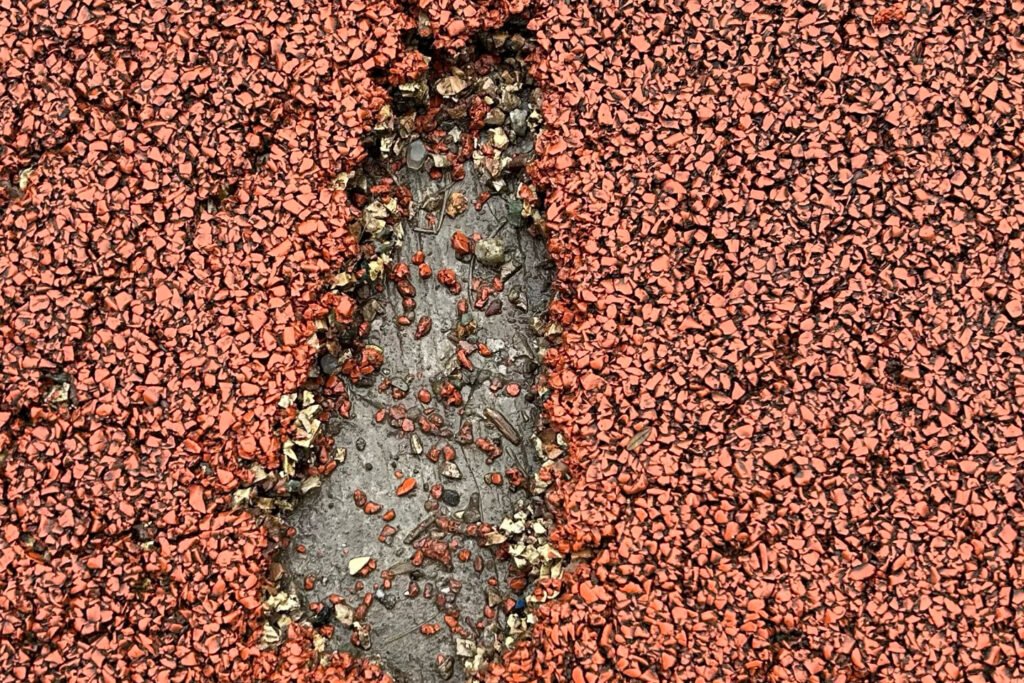
3. Why EPDM Wet Pour Flooring Has Bubbles or Bulges
Bubbles (or “blisters”) are raised areas on the surface.
They feel soft when you push them.
This problem is almost always caused by air or water trapped under the EPDM layer.
3.1 Why bubbles appear
a) Wet base concrete or asphalt
If the ground is still wet inside, moisture tries to escape when the sun heats it.
This pushes the EPDM up and makes a bubble.
b) No primer on the base
If no primer is used, the binder cannot stick well to the ground.
Air pockets can stay between EPDM and base.
c) Rain during curing
If it rains before the EPDM fully cures, water can get into the system and create hollow spots.
d) Very thick bottom layer
If the SBR or low-binder EPDM layer is too thick, air can get trapped inside during mixing and spreading.
e) No way for moisture to escape
If the area has no drainage, water from the ground may push up over time.
3.2 How to fix bubbles
For local bubbles:
- Cut a small “X” on top of the bubble
- Gently lift the flaps and let air or moisture escape
- Wait until the inside is dry
- Fill the hole with a new EPDM and binder mix
- Press and smooth the surface so the repair blends in
For many bubbles over a large area, you may need to remove and re-do the whole section.
In that case, it is also important to solve the moisture or base problem first.
3.3 How to prevent bubbles
To avoid bubbles in the first place:
- Make sure the base is fully dry before installation
- Use a suitable primer on the concrete or asphalt
- Avoid installing right before rain
- Do not make the bottom layer too thick
- Consider simple drainage design if the area is always wet
If your area has heavy use or needs more impact resistance, sometimes rubber tiles are a better choice than wet pour.
You can see different tile options here:
Tiny Granule Rubber Tile
Composite Gym Rubber Tile
Puzzle Rubber Tile
For indoor weight areas like gyms, our gym rubber tiles and gym rubber rolls are more suitable than EPDM wet pour.
A Few Words About Lanhefloor EPDM
I always tell customers: EPDM problems are often “system problems”, not only “material problems”.
At Lanhefloor, we focus on:
- Clean, low-dust EPDM granules
- Good color stability for outdoor use
- Stable particle size for better bonding
- Strong match between granules and binder
- Clear mixing and installation advice
You can see our main site here:
Lanhefloor Rubber Flooring
And more outdoor solutions here:
Outdoor Rubber Floor Systems
Related Articles You May Find Helpful
If you want to read more easy-to-understand guides, you can check:
- Can EPDM Wet Pour Flooring Be Used in a Home Garage?
- How to Choose Reliable EPDM Granules Suppliers in China
- Why EPDM Granules Fall Off After Installation
- One-Component vs Two-Component PU Binders for EPDM Flooring
Conclusion
Whitening, cracks, and bubbles on EPDM wet pour flooring look worrying, but they always have a reason.
Once you understand the cause, the repair and prevention become simple.
With the right material, binder, and installation method, an EPDM playground can stay safe and beautiful for many years.