
Can I Install Rubber Gym Flooring Without Glue?
When planning a gym floor, one of the most common questions we hear is simple but important:
Do I need glue to install rubber gym flooring?
Many gym owners, home gym users, and project contractors prefer a flooring solution that is easy to install, removable, and does not damage the original subfloor. This is especially true for rental spaces, garage gyms, and temporary training areas.
The good news is yes—you can install rubber gym flooring without glue.
The key is choosing the right product: interlocking rubber tiles.
What Is Interlocking Rubber Gym Flooring?
Interlocking rubber flooring is made of rubber tiles with puzzle-style edges that lock together tightly during installation.
Instead of relying on adhesive, these tiles stay in place through their own weight, friction, and the interlocking structure.
This type of flooring is widely used in:
- Home gyms and garage gyms
- Commercial fitness centers
- CrossFit and functional training spaces
- Rental properties and temporary gyms
Compared with glued-down rubber flooring, interlocking tiles offer:
- Faster installation
- No damage to the subfloor
- Easier replacement of damaged areas
- Flexibility to remove and reuse the floor
For customers who want a non-permanent but stable solution, interlocking rubber tiles are often the most practical option.
Two Types of Interlocking Rubber Tiles You Can Install Without Glue
Although interlocking rubber tiles look similar once installed, they are produced in different ways.
Understanding these structures helps you choose the right option for your gym.
Composite Interlocking Rubber Tiles
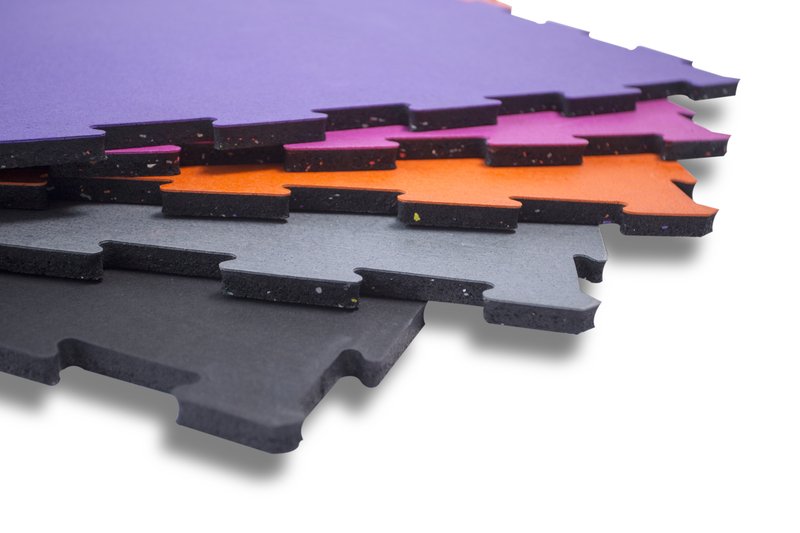
Composite interlocking rubber tiles are produced by first manufacturing a flat rubber tile or rubber roll, and then cutting interlocking edges into the material.
This production method allows greater flexibility in surface design and thickness options.
Key characteristics:
- Flexible structure that is easy to cut on site
- Supports composite surfaces, such as rubber with artificial grass
- Suitable for small to medium-sized projects
- Cost-effective and widely used in gyms
Common specifications:
- Standard sizes: 985 × 985 mm, 500 × 500 mm
- Thickness range: 6 mm to 30 mm
- Popular for home gyms, studios, functional training zones, and garage gyms
Because composite tiles are cut after production, they are especially useful for projects that require custom fitting or mixed layouts.
Related product page:
https://lanhefloor.com/composite-gym-rubber-tile/
Molded Interlocking Rubber Tiles
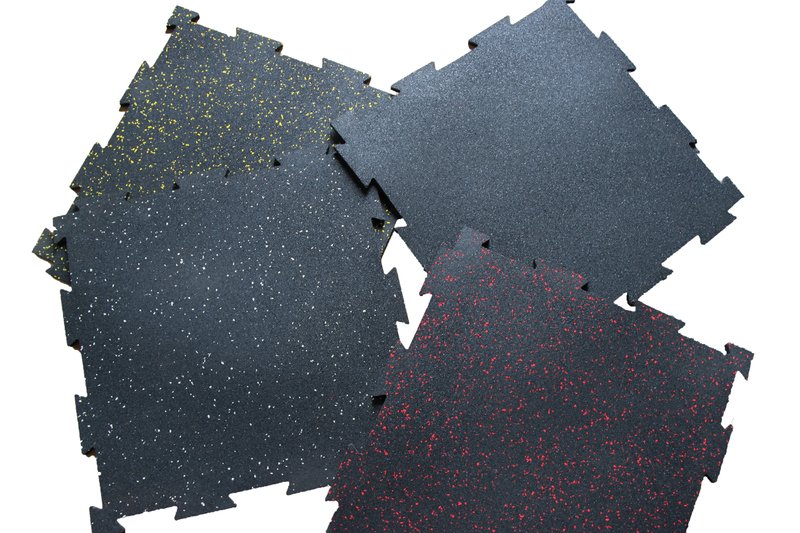
Molded interlocking rubber tiles are produced using high-pressure molding.
The interlocking edges are formed directly in the mold during production, resulting in a one-piece structure.
Key characteristics:
- High edge precision and tight locking
- Uniform appearance and clean edges
- Strong edge durability under heavy use
- Ideal for long-term and high-load areas
Common specifications:
- Standard sizes: 500 × 500 mm, 1000 × 1000 mm
- Thickness range: 10 mm to 30 mm
- Commonly used in weightlifting zones, CrossFit gyms, and heavy-duty training areas
Molded tiles are often chosen when durability and edge stability are the top priorities.
Related product page:
https://lanhefloor.com/puzzle-rubber-tile/
Do Interlocking Rubber Tiles Stay in Place Without Glue?
In most gym applications, yes.
Interlocking rubber tiles stay in place because of:
- Their own weight
- High friction against the subfloor
- Tight puzzle-style edge connections
For better performance, we recommend:
- Installing tiles wall-to-wall when possible
- Using border ramps or edge trims in open areas
- Choosing thicker tiles (15–30 mm) for weightlifting zones
Glue is usually only required for:
- Permanent installations with extremely high traffic
- Very smooth or sloped subfloors
- Large commercial gyms with constant equipment movement
For most home and commercial gym projects, glue-free installation is more than sufficient.
Where Interlocking Rubber Flooring Works Best
Interlocking rubber tiles without glue are especially suitable for:
- Home gyms and garage gyms
- Rental commercial spaces
- Weight training areas
- Functional training and CrossFit zones
- Temporary or modular gym layouts
You can view real project examples here:
https://lanhefloor.com/projects/
Installation Tips for Glue-Free Rubber Gym Flooring
To get the best results, follow these basic installation tips:
- Let the tiles rest in the room for at least 24 hours before installation
- Ensure the subfloor is clean, flat, and dry
- Start installation from the center and work outward
- Cut edge tiles carefully for wall alignment
- Use edge ramps if needed for safety and appearance
These steps help prevent gaps and ensure long-term stability.
Frequently Asked Questions
Can I install interlocking rubber tiles over concrete or wood?
Yes. As long as the surface is flat, dry, and stable, interlocking tiles can be installed without glue.
What is the minimum thickness for gym interlocking tiles?
The minimum thickness can be 6 mm, which is suitable for light training or home gym use.
Are interlocking rubber tiles reusable?
Yes. One of their biggest advantages is that they can be removed and reinstalled multiple times.
Do I need glue for heavy lifting areas?
In most cases, thicker interlocking tiles (20–30 mm) provide enough stability without adhesive.
Conclusion
If you want a gym flooring solution that is easy to install, removable, and does not damage your subfloor, interlocking rubber tiles are an excellent choice.
By selecting the right structure, size, and thickness, you can build a stable and professional gym floor—without using glue.
For product details, samples, or project advice, visit:
https://www.lanhefloor.com