
What Rubber Thickness and Structure Are Recommended for Shooting Ranges?
Choosing the right thickness of rubber flooring for a shooting range isn’t as simple as picking the thickest tile available. Safety, structure, and application zones all play a role.
Rubber thickness must be matched with the right structure and application area. For ballistic safety, thicker tiles alone are not enough—rubber structure and density matter more.
Many buyers ask us: is 50mm thick enough? Is gym flooring suitable for backstops? In this article, I’ll explain which thickness and structure combinations actually work under real shooting range conditions.
Why Is Thickness Alone Not Enough for Shooting Range Safety?
You might assume that a 60mm rubber tile is safe enough for ballistic impact. But in reality, if the tile is made from fine SBR granules, bullets can still tear through it.
Thickness without density and structure is like armor made of paper—thicker, but not stronger.
We discussed this in detail in a previous article:
👉 Can Rubber Tiles Be Used in Shooting Ranges?
That article explains why tiny granule rubber tiles are not safe for direct bullet impact, even when thick.
What Rubber Thickness Is Recommended for Each Zone?
To make this clear, we organized real-world applications into three safety zones:
| Zone | Recommended Thickness | Recommended Structure | Function |
|---|---|---|---|
| Floor Zone (Ricochet Reduction) | 40–60mm | High-density molded or laminated rubber | Absorb downward impact, reduce rebound |
| Wall Side Protection | 50–80mm | Long-strand rubber or layered rubber block | Fragmentation control, side ricochet dampening |
| Bullet Trap / Impact Stop | 80–100mm+ | Ballistic rubber block (continuous mass) | Stop bullets, energy absorption, self-healing surface |
What Rubber Structures Perform Best Under Ballistic Impact?
✅ Recommended Structures
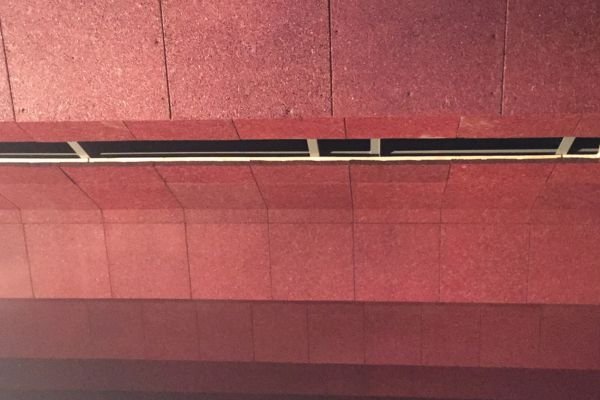
Rubber structure matters more than just surface appearance. The following types perform best under real shooting conditions:
1. Long-strand or fiber-filled rubber
- Made from recycled tire strips, not fine powder
- High tear resistance
- Self-heals better over time
2. Continuous molded blocks
- Extremely dense rubber mass
- No weak bonding points
- Designed to slow or stop high-velocity projectiles
❌ Structures to Avoid
- Fine SBR granules
→ Easily torn by bullet energy paths - Foamed or EVA layers
→ Compress under pressure, not built for penetration - Low-density composite tiles
→ May look thick, but fail under impact
Can Rubber Thickness Be Customized?
Yes. At Lanhefloor, we support a wide range of thickness options depending on the project requirements.
🔧 Our Capabilities
- Rubber tile thickness: 15mm to 60mm
- Rubber blocks / ballistic panels: Up to 100mm (OEM/custom cut)
- Rubber roll thickness: 3mm to 12mm
→ Great for walkways, prep zones, and yoga-style training rooms
Check out our gym rubber tile options for high-density impact zones, or explore rubber rolls for non-impact areas.
If you are working on an outdoor shooting training facility, we recommend using UV-resistant, weatherproof rubber with dense structure.
For surrounding areas such as walkways or non-shooting zones, we also offer outdoor rubber flooring and EPDM granules as auxiliary safety surfaces.
Frequently Asked Questions (FAQ)
What thickness of rubber is best for a bullet trap?
At least 80mm, using a dense ballistic rubber block with continuous structure. For high-caliber use, 100mm+ is preferred.
Is 50mm rubber tile safe for a shooting range floor?
Yes, if used in ricochet reduction zones, such as the floor under shooting lanes. But not for direct bullet impact zones.
Can I use the same rubber tile for floors and backstops?
No. Floors can use heavy-duty tiles. Backstops require ballistic-grade rubber, which is denser and structurally stronger.
Does thicker rubber reduce ricochet?
Yes. Thicker and denser rubber helps absorb the energy of stray bullets or fragments, reducing ricochet risk.
Can Lanhefloor provide customized thickness?
Yes. We can support OEM thickness, layered tile solutions, and even mold-cut ballistic panels upon request.
Reach us at info@lanhefloor.com.
Conclusion
For shooting ranges, thickness is important—but structure is critical.
Use 40–60mm for floors, 60–80mm for walls, and 80–100mm+ for bullet traps, with the right rubber composition.
Explore our rubber solutions at:
🌐 https://www.lanhefloor.com