
Can Rubber Tiles Be Used for Shooting Range Flooring?
Shooting range flooring faces very different challenges compared to gym floors. High-speed bullet impact, ricochet risk, noise control, and long-term safety all make material selection critical. Many project owners and contractors ask whether rubber tiles are truly suitable for shooting ranges.
Rubber tiles can be used for shooting range flooring, but only when the correct rubber structure and application zones are clearly defined. Not all rubber tiles perform the same, and fine granule rubber tiles are not suitable for direct bullet impact zones.
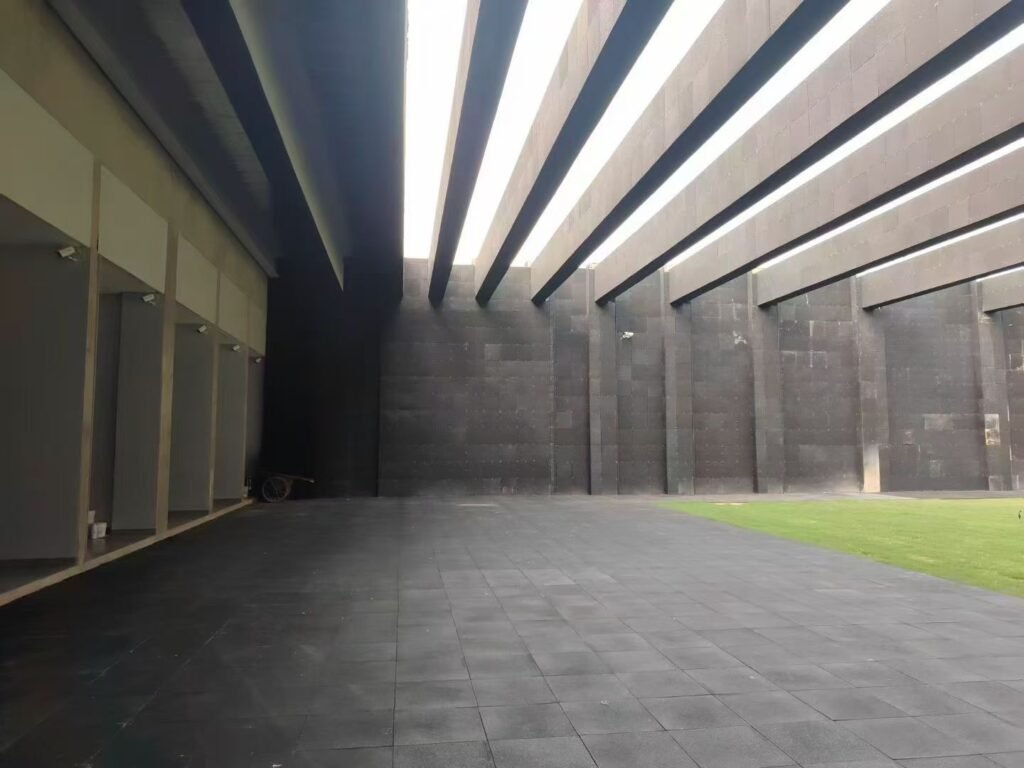
I often receive inquiries from buyers who already use rubber flooring in gyms or training facilities and want to extend the same material to shooting ranges. The confusion usually comes from assuming all rubber behaves the same. In reality, rubber structure matters more than thickness alone.
Why Is Rubber Flooring Used in Shooting Ranges?
Shooting ranges are high-risk environments. When bullets strike hard surfaces such as concrete or steel, they can fragment or ricochet, creating serious safety hazards.
Rubber flooring is used because it absorbs energy through deformation instead of reflecting impact.
This helps reduce ricochet, lower noise levels, and protect the structural slab beneath.
In many indoor ranges, rubber flooring is applied as:
- Floor impact protection
- Ricochet reduction layers
- Secondary wall protection
This is similar in concept to heavy-duty gym flooring, but the performance requirements are much higher.
Bullet Impact Is Not the Same as Weight Impact
This distinction is critical.
In gym applications, rubber tiles mainly handle:
- Vertical compression
- Heavy but slow impacts
- Repeated static loads from weights
Bullets behave very differently:
- Extremely high velocity
- Highly concentrated energy
- Cutting and tearing force rather than compression
Because of this, rubber designed for gym use does not automatically perform well under ballistic impact.
Why Tiny Granule Rubber Tiles Are NOT Suitable for Bullet Impact Zones
Tiny granule rubber tiles are common in gyms because they perform well under heavy weightlifting. However, their internal structure becomes a weakness under ballistic conditions.
Structural Limitation of Fine Granule Rubber
Fine granule rubber tiles are typically made from:
- Small, irregular SBR particles
- Bonded together through point-to-point connections
- Designed to resist compression, not penetration
Under bullet impact:
- The projectile follows weak bonding paths
- Granule connections tear apart
- Penetration channels form quickly
Even at increased thickness, fine granule rubber tiles can be penetrated by bullets.
For this reason, tiny granule rubber tiles should not be used in primary bullet impact zones or bullet trap areas.
What Rubber Structure Works for Bullet Impact Zones?
Rubber used in true ballistic applications has very different structural characteristics.
Key Features of Ballistic-Grade Rubber
Continuous rubber mass or strip-like structure
Long rubber strands or fiber-like structures force bullets to tear through material instead of slipping between particles.High elasticity and tear resistance
Toughness matters more than hardness. The rubber must resist tearing and maintain integrity after impact.Sufficient thickness for energy dissipation
Ballistic rubber blocks commonly range from 60mm to over 100mm thick, depending on use frequency and caliber.
This explains why many professional bullet trap systems use rubber blocks made from recycled tire rubber with long fiber content, rather than fine granules.
Where Rubber Tiles CAN Be Used in Shooting Ranges
Although fine granule rubber tiles are unsuitable for direct bullet impact, rubber flooring still plays an important role in other zones.
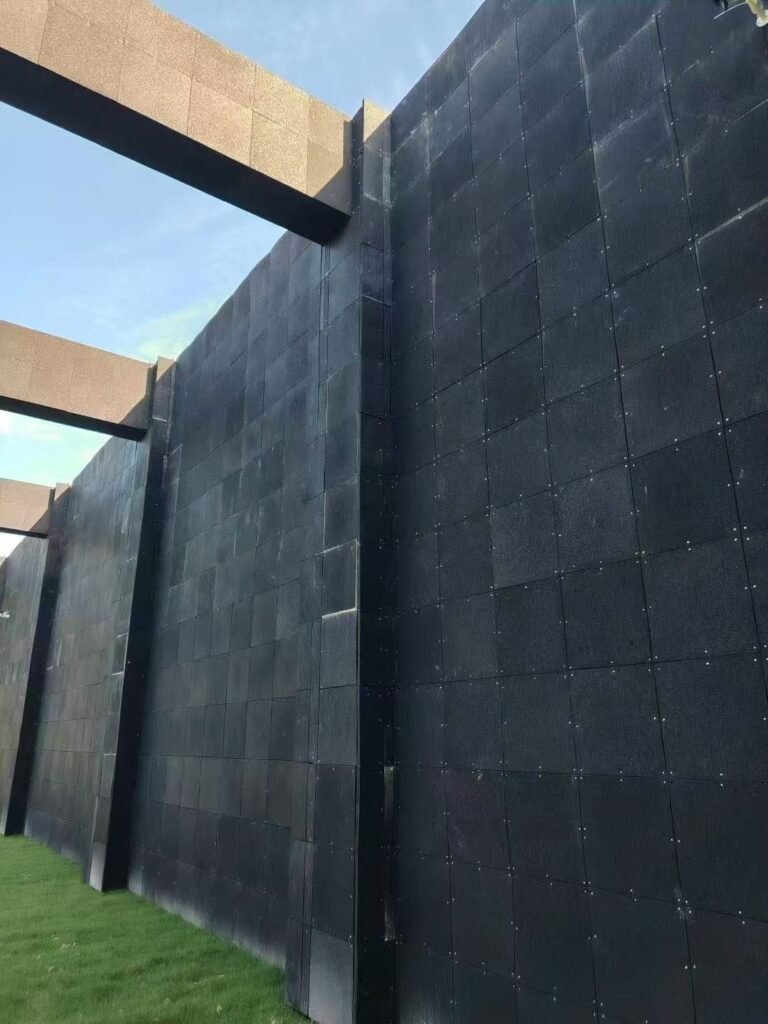
1. Shooting Range Floors (Ricochet Reduction)
Rubber flooring is widely used on shooting range floors to:
- Reduce ricochet risk
- Absorb downward impact
- Protect concrete slabs
- Lower noise and vibration
In these zones, rubber acts as a secondary safety layer, not a bullet-stopping system.
2. Side Walls and Secondary Protection Areas
Rubber panels or tiles are often installed:
- Behind steel bullet traps
- On side walls
- In non-direct fire zones
Here, the function is to reduce fragmentation and noise rather than stop bullets directly.
3. Modular and Replaceable Safety Layers
One advantage of rubber tiles is modularity. Damaged sections can be replaced individually, reducing downtime and long-term maintenance costs for shooting range operators.
Can Gym Rubber Flooring Be Adapted for Shooting Ranges?
Standard gym rubber tiles can be adapted for:
- Shooting range floors
- Ricochet reduction zones
- Non-impact walkways and preparation areas
For example, heavy-duty gym rubber tiles commonly used in weightlifting areas can be reviewed here:
https://lanhefloor.com/gym-rubber-tile/
For non-impact areas such as corridors or staff zones, rubber rolls are also commonly used:
https://lanhefloor.com/gym-rubber-roll/
However, direct bullet impact zones require specialized ballistic rubber materials, not standard fine granule gym tiles.
You can explore our full rubber flooring solutions here:
https://www.lanhefloor.com
Frequently Asked Questions (FAQ)
Can rubber flooring stop bullets?
No. Rubber flooring is not designed to be bulletproof. Its role is to absorb impact energy, reduce ricochet, and improve safety as part of a complete shooting range system.
What thickness of rubber flooring is recommended for shooting ranges?
For floor and secondary protection zones, rubber flooring typically ranges from 40mm to 60mm. Bullet trap systems use much thicker ballistic rubber blocks, often 60mm to 100mm or more.
Is fine granule rubber safe for shooting range floors?
Fine granule rubber tiles can be used on floors for ricochet reduction, but they should never be used in direct bullet impact zones.
Does shooting range rubber flooring need ballistic certification?
Rubber flooring used for impact absorption or ricochet reduction usually does not require ballistic certification. Certification is required for primary bullet traps and structural stopping systems.
Is rubber flooring easy to maintain in shooting ranges?
Yes. Rubber flooring is modular and durable. Damaged sections can be replaced individually, which helps reduce long-term maintenance costs.
Conclusion
Rubber tiles can be used for shooting range flooring when the correct rubber structure and application zones are clearly defined. Fine granule rubber tiles are not suitable for bullet impact zones, while continuous, high-toughness rubber structures perform far better under ballistic conditions. Understanding these differences is essential for safe and effective shooting range design.