
How to Calculate Quantity for Rubber Rolls and Tiles Before Ordering?
Getting the quantity wrong when ordering rubber flooring leads to wasted money, delays, or mismatched batches.
This guide shows how to calculate the correct amount of rubber rolls or tiles for your gym project.
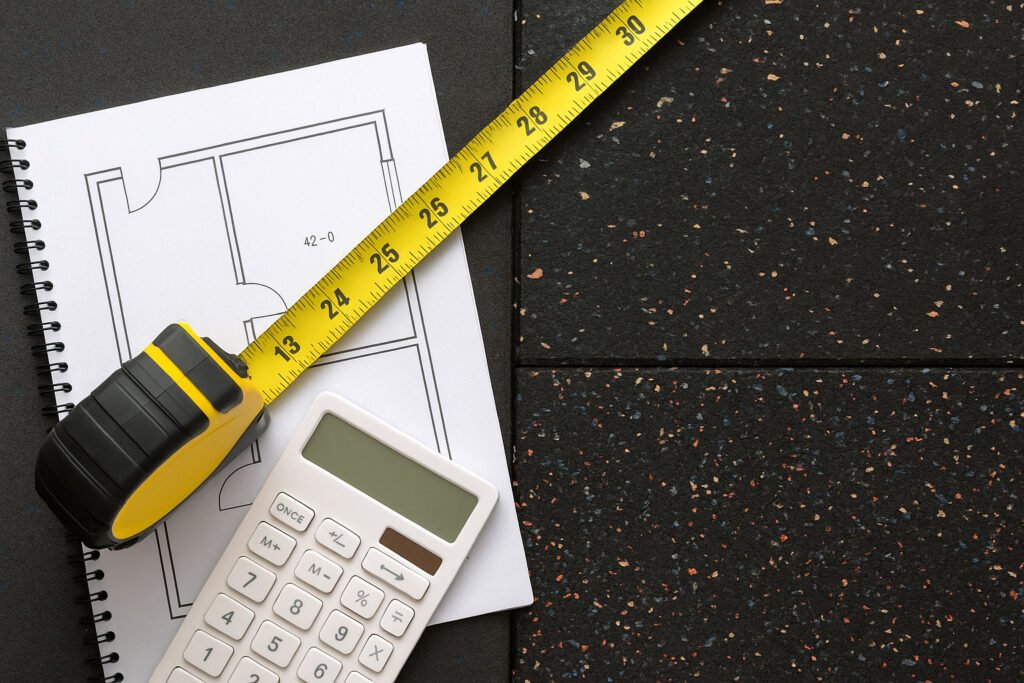
Small calculation mistakes can turn into big logistics problems. Here’s how to avoid them.
How to Measure Your Gym Floor Accurately?
Start with the right measurement process. This determines all the following calculations.
Measure the full width and length of your room in meters, then multiply to get total square meters (m²).
- Use a laser or tape measure for accuracy.
- Break large or irregular spaces into rectangles.
- Subtract fixed obstacles like pillars, ramps, or built-in equipment if they won’t be covered.
- Always measure wall-to-wall, not just usable area.
Example:
Room size: 12m × 8m = 96m²
How to Calculate Quantity for Rubber Tiles?
Rubber tiles come in standard sizes: 1m × 1m, 985 × 985 mm, or 500 × 500 mm.
To calculate:
- Convert your floor area into m².
- Divide that by the area of a single tile.
- Add 5–8% for trimming, cutting loss, and future replacement.
Example:
For a 985mm × 985mm tile (0.97m² coverage), and a 96m² gym:
Required: 96 ÷ 0.97 ≈ 99 tiles
Add 5% buffer: ≈ 104 tiles total
| Tile Type | Size (mm) | Coverage per tile (m²) | Recommended Use |
|---|---|---|---|
| Standard Tile | 1000 × 1000 | 1.00 | Heavy zones, easy layout |
| Precision-cut Tile (985mm) | 985 × 985 | ~0.97 | Interlock-ready, flush-fit |
| Puzzle Tile | ~500 × 500 | ~0.25 | Easy DIY, fast replacement |
How to Calculate Quantity for Rubber Rolls?
Rubber rolls are typically 1 meter wide, and you customize the length.
To calculate:
- Measure your room’s area.
- Divide it by roll coverage (width × length).
- Round up to the nearest roll.
- Add 5–10% for cutting loss or overlaps.
Example:
Using 1m × 10m rolls (10m² each), and a 96m² room:
96 ÷ 10 = 9.6 → 10 rolls
Add 5% buffer = 10.5 → Round up to 11 rolls
| Roll Type | Width | Thickness | Standard Lengths | Ideal For |
|---|---|---|---|---|
| SBR Roll | 1.0m | 4–12mm | 8m, 10m, 15m | Cardio & general zone |
| 15% EPDM Fleck | 1.0m | 6–10mm | Customizable | Budget + style blend |
| Full EPDM Roll | 1.0m | 6–10mm | Customizable | Premium, vibrant color |
Layout Planning Tips: Tile vs Roll
| Criteria | Rubber Tile | Rubber Roll |
|---|---|---|
| Cut Flexibility | Easier for corners & columns | May waste full strip width |
| Seams | More visible joints | Minimal seams, seamless look |
| Cost per m² | Slightly higher | More efficient in large areas |
| Labor | Easier DIY | Requires glue & tools |
| Maintenance | Easy replacement | Less modular |
✅ Learn more about Puzzle Rubber Tiles and Laminated Gym Tiles
How Much Wastage Should You Include?
Add buffer to your final order to account for:
- Cutting loss around walls, pillars, or curves
- Color batch variations (especially EPDM)
- Future replacements (tile damage, repairs)
General Rule of Thumb:
- Add 5% for square rooms
- Add 8–10% for complex layouts
📌 Better to have a few extra pieces than to reorder small batches.
Before You Order: 5 Final Checks
- ✅ Have you measured net usable space accurately?
- ✅ Is your surface shape square or irregular?
- ✅ What thickness is suitable for each zone?
- ✅ Do you plan for future replacements or branding needs?
- ✅ Do you need pre-cut or full-size rolls?
Need help? Contact us with your layout — we’ll calculate it for you.
FAQs
1. Should I add extra tiles for future repairs?
Yes, we recommend at least 5–10% extra tiles to ensure future color match and fit.
2. Can I mix tile and roll in one project?
Yes, many gyms use roll in cardio zones and tiles in free-weight zones.
3. What’s the most efficient tile size?
985mm precision tiles are a good balance between size and layout efficiency.
4. Can I reuse rolls from a previous project?
Only if they’re not damaged and match in color batch, thickness, and wear.
5. Do you offer layout services?
Yes. Send us your room dimensions, and we’ll give a full quote + layout plan.